


Customers ask me this all the time. Which one should I get? And look — I'll be straight with you. There's no wrong answer here. Every Holo Audio DAC is genuinely good. The question is just which one fits where you're at right now.
We stock three models: the Cyan 2, the Spring 3, and the May. USA prices start at $1,498 and go up to $6,198.
Note on pricing — everything listed here is USA only, current as of March 2026, and can change. We keep domestic inventory which means faster shipping but also different costs than international. Canada, Japan, and Mexico customers — your pricing shows up automatically when you visit the product pages. It's lower.

Why Holo Audio?
Honestly, because nothing else sounds quite like it at these prices.
The short version: Holo Audio doesn't use DAC chips. Jeff Zhu — the guy who designs all of this — builds the conversion ladder himself from precision resistors. It's called R2R, or resistor ladder architecture. Takes more work, costs more to produce, and most manufacturers don't bother. But the payoff is a sound that a lot of people — myself included — just find easier on the ears. Less fatiguing. You can sit with it for hours and not feel like you need a break from it.
All three models run in NOS — Non-Oversampling. That means the signal hits the converter without any digital processing added. Most of our customers hear it once and never go back. The May also has an OS mode, and some people like it. But NOS is where almost everyone lands.
We're the official US distributor. Only place in the country where you get a new Holo Audio product wired for 110V out of the box. Ships from our warehouse, usually within a week.

Holo Audio Cyan 2 — $1,498
People sleep on the Cyan 2 because it's the cheapest of the three. Don't. This isn't some watered-down entry-level thing — it's a real discrete R2R DAC, same basic design philosophy as the Spring and May, just smaller scale. You're not buying a lesser product. You're buying a smaller one.
Plug it in and it sounds like Holo Audio. That smooth, organic thing that's hard to explain until you hear it. Handles high-res, handles DSD, no issues. For a desktop rig or someone's first real DAC, it punches well above what you'd expect at $1,498.
But before you order — there's something I always tell people about the Cyan 2.
The fix is simple: only power on the source you're using. Keep other devices off. If you're the type who has a lot of sources running simultaneously and wants to switch between them freely, the Spring 3 with its manual input selection is a better fit. But for a clean, focused setup? The Cyan 2 is excellent.
Good for: first serious DAC, desktop setup, simple one or two source systems, anyone who wants into R2R without a huge commitment.

Holo Audio Spring 3 — from $2,998
The Spring 3 is where I start most conversations when someone calls without a firm budget. It's been Holo Audio's workhorse for years, and the third generation is the best version yet. Better power supply, more refined output, manual input selection so you're not fighting the auto-switch. And if you go KTE — which I'll get to — it gets uncomfortably close to May DAC territory for a lot less money.
We offer six variants — three tiers, each available with or without the optional built-in preamp module.
What about the preamp module?
The preamp module — we call it the PAM — is available only on the Spring 3. Not on the Cyan 2, not on the May. If you're building a pure digital system and want to connect straight to a power amp or active speakers without a separate preamp, the Spring 3 with PAM is a genuinely great all-in-one solution. It's a fully balanced, fully discrete analog preamplifier with 84 steps of 1dB volume control.

One thing to be clear about: the PAM attenuates digital inputs only. The Spring 3 has no analog inputs at all — no phono stage, no tape loop, no RCA line-in. If your system includes a turntable, tape deck, reel-to-reel, or any other analog source, you'll need a separate preamp with analog inputs. The PAM is for pure digital setups only.


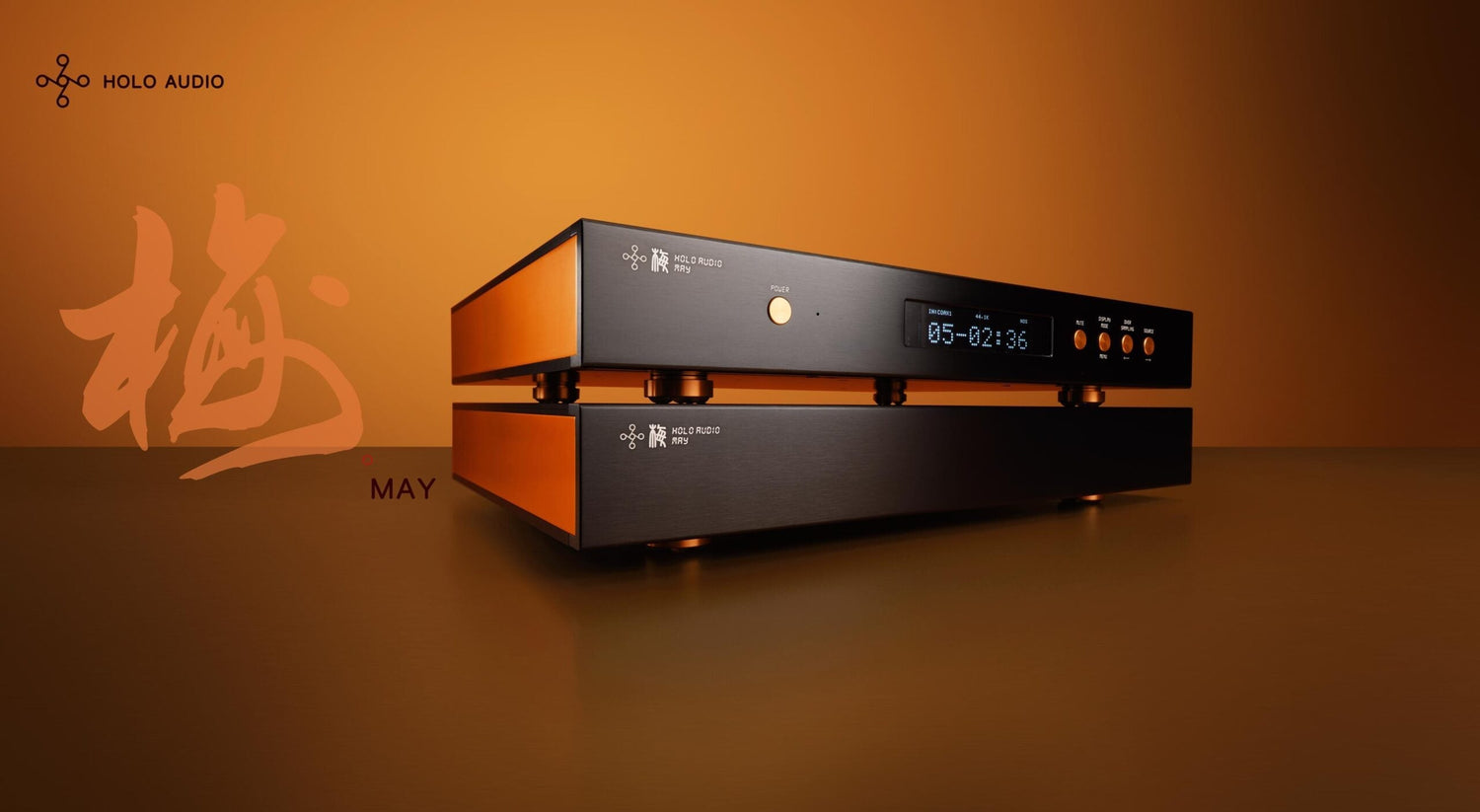
Holo Audio May DAC — from $4,798
The May is the one. Stereophile Product of the Year. Reviewers calling it one of the finest-sounding DACs at any price. I live with one. I get it. My wife has one on her desktop as well! She gets it too!
What makes the May different from the Spring 3 isn't just better parts — it's a fundamentally more advanced design. Full differential dual mono design. Having a dedicated Dac module per channel as well as dedicated power supplies per channel. Jeff Zhu added a second Dac module, and a separate chassis holding all the power supply components separately. While the Spring 3 has one Dac module, the May has two of these same modules running in a Dual Mono Configuration. The module digitally trims resistor tolerances to 0.00005% accuracy. The result is extraordinary measured performance — noise floor levels that very few DACs at any price can touch. And it sounds like it.
Spring 3 KTE or May — the honest answer
Honestly, if you're torn between the Spring 3 KTE (without preamp, $3,898) and the May Level 1 ($4,798), I'd stretch to the May. The gap isn't that wide, and you're getting a meaningfully different piece of equipment.
If you're comparing Spring 3 KTE to May KTE — that's a bigger gap and a real decision. In a highly resolving system, the May KTE earns it. In a more modest setup, the Spring 3 KTE will likely be the best thing in the chain. Buy what your system can actually reveal.
Quick reference
| Budget (USA) | What I'd suggest |
|---|---|
| $1,498 | Cyan 2. Real R2R, great for a clean simple setup. |
| $3,000–$3,500 | Spring 3 Level 1 or Level 2. Solid performer, manual inputs, remote included. |
| $3,900–$4,500 | Spring 3 KTE. The Spring 3 doing everything it's capable of. |
| $4,800–$6,198 | May DAC. Start at Level 1, go KTE if you want the absolute best. |
A few things every Holo Audio DAC has in common
- Fully discrete R2R architecture — no off-the-shelf DAC chip
- NOS mode on all models (OS mode on May only)
- Native DSD support (dedicated discrete architecture for DSD)
- Ships from US inventory — fast, no customs headaches
- 110V configured for US, Canada, Japan, Mexico
- Direct support from me — I've used this gear, I know it well

One more thing — the Holo Audio Red
If you're streaming — and most people are — take a look at the Holo Audio Red ($998). It's a network streamer and DDC that connects to your Holo DAC via HDMI i2s. Roon, Qobuz, Tidal, Spotify, Audirvana, Jplay, HQplayer, AirPlay 2 — it does it all.
The i2s connection bypasses USB entirely. On every Holo DAC I've heard, i2s is the best-sounding input. It's a pairing that makes a real difference and one I recommend often. We implement a unique 4 way i2s circuit you won't find in other products. This 4 way circuit improves i2s quality even further to deliver the best i2s experience. Remember to get a great i2s cable that isn't too long or will defeat the purpose of I2S and won't enjoy it's benefits. I would recommend our Premium 0.5m I2S cable here.
Next, I'll put together a blog posting about the Serene and Bliss and how these great products will pair with the DACS we discussed and go over which one would be right for you if you are choosing a preamplifier or headphone amplifier to complete your overall system.
All Holo Audio products are available exclusively in the US through KitsuneHiFi. Not sure which way to go? Reach out — happy to talk through your system.
- USA prices listed as of March 2026, subject to change. Regional pricing for Canada, Japan, and Mexico displays automatically on product pages.
(Below is a list of our dealers, please contact them if you are in the country they are located in)
if you are in Europe/(not UK) and potential other areas nearby, please contact our European Authorized HoloAudio Dealer for the best service and support in your area, Magnahifi.com
If you are in UK area please contact our dealer Elise Audio for the best support in UK area specifically.
If you are in South Korea, please contact our dealer in South Korea – SonorisAudio
If you are in Hong Kong, please contact our dealer WildismAudio - WildismAudioHK
If you are in Australia, please contact IndiHifi.com.au, your source for HoloAudio in Australia